Sunday, May 6, 2007

Chicago, New York, Toronto... Our life in April

Dearest Friends,

I know it has been awhile since we have posted anything, but I so much wanted to share our pictures with you, and was so reticent to fight with Mike's laptop to download them, it has taken me till now--in high thesis writing and apartment packing avoidance mode--to actually do it. I am hoping for another post later (sooner, rather than later, though...) about our current plans for the summer and the fall, so I will just stick with the fun stuff for now.

Two weeks ago, just a day after the ICS spring retreat, Jeff, Angie, Mike and I headed down to Chicago. It was a whirlwind trip where I got to stay with my sister, Katrina, on her wonderfully comfortable futon in the (almost) only current TCC dorm I had never before stayed in. This was my homebase for the couple days of non-stop interviews all over the city (more on the results in the coming post...) Mike stayed with various friends around Chicago--shadowing Bob Phelan at school and attending class at the University of Chicago (If you want to know more, you'll just have to ask him--I really wasn't there most of the time!). Anyway, we got back after a couple of days and I promptly got sick--really sick. Not that I minded so much, yeah I had a course paper to do, and the ever-present thesis to write, but I had just received from my sister-courier a book that I had been dying to read: *French Lovers* by Joseph Barry. So good. I didn't mind a bit staying in bed and reading more about Heloise and Abelard, the courtly love tradition, and royal scandals with Catherine de Medici and Diane de Poiters.

Just about the time I was getting better, I was packed off and heading to Syracuse, NY with Jim Olthuis and his wife, Arvilla for a conference put on by their good friend Jack Caputo entitled "Feminism, Sexuality and the Return of Religion." What an awesome trip. As an added bonus, we made a stop off at Seneca Falls, NY on the way to see where the Women's Rights movement really got started, and the current National Women's hall of Fame. It was amazingly empowering to see all the women that had come before, making it possible for me to attend a school of Higher Education, vote, and have so many other opportunities. (Pictures here--Me and Jim outside the National Women's Hall of Fame, and the plaque commemorating that important day in 1848 where Elizabeth Cady Stanton called together the first women's convention in the US.

So, from there it was off to the conference. It was somewhat of an ICS reunion, that I was honored to be a part of, meeting current students who are living outside Toronto, and re-connecting with ICS graduates that I had known before. (To the right is a picture from dinner on Friday night--from left, Clarence Joldersma (Calvin Professor and ICS senator), Neal's friend Will, Neal DeRoo (ICS grad and current Boston College PhD student), Yours Truly, RuthAnne Crapo (Current ICS PhD student and Professor in Kentucky), Beatrix Prinsen, Dianne Bergsma (Current ICS PhD student and Professor at Brock in ON), Christina DeGroot (Chair of the Gender Studies Department at Calvin College), Arvilla Sipma, Jim Olthuis (ICS emeritii professor).

The speakers (well, most of them) were also fantastic. They had been brought in from all over the world from prestigious institutions of higher learning, and it was very impressive. As a result of Sarah Coakley's tantalizingly brief reference to Simone Weil at one point in the question part of her talk, I couldn't help talking to her afterward, and find out what she really did think about this woman who was becoming such an important part of my life. We had a good discussion (if you really want to hear about it, please ask me!). (See Sarah's picture to the right--->) Another of the interesting lectures was Judith Butler's. She couldn't make the conference, so they piped her in by interactive video. People got to ask questions still, and we all could see her face on the giant projector. (See picture to the left <--- of her on the screen and people coming up to ask questions) Such a great presentation! I also got to sit down to dinner on Saturday night with Jack Caputo, Merold Westphal and Jim Olthuis. Nothing like feeling like the little kid at the grownups table!

Well, I hope to write an update soon of work and housing plans... Enough for now.

Sunday, April 22, 2007

Reflections on Virgina Tech

Since we have been gone for the last couple days in Chicago, I haven't had a chance to transcribe my thoughts about Virgina Tech. This journal was written in the car after arriving an hour early to the last of my blitz krieg of interviews in the beginning of the week. It was good to take some time and reflect on the changes that had been happening over the last couple days. More about the trip to Chicago soon.

******************
18.April.2007
Last night I participated in a vigil at Trinity Christian College with my RA sister and close to, if not more than 100 other Trinity students. It was a striking experience for me, recalling a time just over five years ago where as an RA, I also had to lend support and sympathy and be a strength for people at TCC. It was 9-11-2001. As I looked across the circle of faces in the courtyard last night, though--dimly lit by torches and other (all too-breakable) tea light holders, I saw some familiar faces--now in positions of leadership at Trinity, and some faces that seemed familiar, until I realized that the people I was thinking of had graduated years before. Regardless, the continuity was striking. Where my peers had taken roles of leadership, so did these current college students step naturally into those roles. I was reminded of the French saying that I had read only that afternoon: Plus ca change, plus c'est la meme chose (the more things change, the more they stay the same).

By catching a glimpse of continuity at my alma mater, I was overwhelmed with a sense of time's cyclicality. Though we often use a linear model of time, that seems to me, quite a human and rational imposition on reality. Nature moves in cycles. The seasons, the days, the very sphericalness of our earth, connote a cyclical understanding that what has come before will come again, though we might be in a different place, and see a different perspective on it. This metaphor also made me think of the labyrinth experience at the most recent ICS retreat. In my constant circling around, I gained a sense that I had been in this spot already, though it was already a ways down the path (if it was stretched out linearly). The power of the cyclical metaphor also translates well to Buddhist mysticism that Mike introduced to me. He said that Buddhists see life as on a wheel. There are people hanging on to the outside, desperate to stay connected, always in danger of falling off. There are also people who sit peacefully in the center, as the good and bad pass through them. What a powerful image for me as I stood in the center of the labyrinth circle and once again in the Trinity circle, surrounded by people that were seeking that inner peace in the face of a tragedy.

Continuity and change--what powerful human concepts. Our ability to pick them out is striking and profound, and so very human. Maybe our human linear understanding does help us project into the future... By realizing how tragedies like what happened this week in Virgina share with other prior tragedies, we can make a commitment to change the future. By realizing our responsibility for building community instead of isolating people, we can see ourselves as quite a ways down the path, though it may not seem so very different, after all.

Monday, April 2, 2007

Important! Short! Pleae Read!

This is Mike again--but I promise that this time I won't go into an angst-filled soliloquy. Really.

Basically, this is just a feeler relating to our plans for the near future. Since we are heading back to the states, we will most likely jump back on the cellphone train and ride it into the sunset. But we are up in the air about which company to sign on with. That is where you, dear friends, come in. If you anticipate or want to talk to us on a semi-regular basis without eating up your minutes or waiting ever so impatiently for 9 pm to roll around, let us know your wireless carrier. Or, if your wireless carrier is rubbish and you are going to switch as soon as that 50 year contract you signed runs out, warn us.

I'm gonna tag some people on facebook; if I don't tag you it's probably because I know your carrier. Or I forgot. Or I don't like you. So take a hint.

Thursday, March 29, 2007

How to (not) write a thesis on textualized monastic despair

One-- Wake up late after telling yourself the night before you will get up early. This gives you a fantastic start for your attitude of failure that will carry you through those slothful afternoon hours.

Two-- take three hours to “just check your email” before you start work for the day. Few things are as excellent time wasters as the Internet, and you want to exploit them fully. However, if you are able, watch some morning television news magazine such as Good Morning America, or convince yourself that you should go out and read a newspaper.


Three-- Find some appropriate music to set the soundtrack of your day. Make sure it is something good 'n depressing, especially on a cultural level. I usually go with Bright Eyes, although there is certainly a wide selection of indie emo you can choose.


Four-- Open your document on the computer. Now you can try to fool yourself that you will get some work done.


Five-- Change the first line as many times as possible before your skin begins to crawl. For
me, this usually begins at the back of my knees, but I recognize the full effect when my lower back begins to sweat. A favorite at this stage is to change word order in one or two sentences. Should that phrase be a genitive, “of Bernard?” Or should I change it to a possessive: “Bernard's?” Or, should I re-structure the sentence entirely as a prepositional phrase, “in the system wherein Bernard is situated?” Usually go with the most convoluted result, but don't hesitate to continue with this until you hands are completely sore from cracking and re-cracking your knuckles.


Six-- Decide you need some coffee. Of course, this means you also have to do dishes, scrub the counter, sweep the floor, and start a load of laundry. Also feel free to inspect the mail and leaf through the Liturgical Press catalogue for an hour or so.


Seven-- Return to writing after three cups of coffee. You're jittery, so you will probably write at least three more sentences. Reward yourself with a game or seven of free cell, since not everybody can write a whole 65 original words in the span of four hours!


Eight-- Realize that you have realized that everything you have done today is a diversion from the underlying dread of staring at yourself in the reflection of the blank page on your monitor. In response to this, begin thinking about your plans for next year and how they resemble a jenga tower teetering on this fulcrum of this thing you are failing to write.


Nine-- pace around the room for at least fifteen minutes. Pick up a book and start furiously reading and underlining. Make sure it is one of yours, or else somewhere a librarian will have a conniption.


Ten-- turn off the Bright Eyes CD that has been repeating for the past five hours. Slap yourself around physically, mentally, or both.


Eleven-- Your constant rumination on the failures of the past several hours, along with the overload of caffeine, have probably depressed you to the extent that your mindset is approaching the point required to posses the realization of your own depravity required for true monastic reflection. Write two paragraphs, then read a bit more before you put the laundry into the dryer, and while you are doing that, welcome any other distraction that presents itself for your exploitation.


Twelve-- Pour your frustrations into the chapter you're writing, turn it in, receive glowing feedback from your advisor, do the same for the other chapters, and finish your thesis in record time with an exemplary grade.


Except the last point hasn't happened. And it probably won't. But it's a hope for the future that is the corona slithering behind the eclipse of the present despair, the shadowy light that reveals your true being in what is written by your hands. Read what you wrote again. Then read your proposal and modify it a bit. Then notice how this slice of the past and the plan for the future completely miss each other in the present. Now you write about writing, again. Now you are distanced from yourself once more, but for a time it is close enough to be the present. And even that contains another model condemning your understanding of you right now, since here you see yourself clearly by seeing exactly what you aren't, but should be. Et jam incepit...


Lucky number thirteen, with a bullet-- Stare at the computer screen, losing yourself in what you have written so that your skin is wrapped in the words of the page. Every letter is a molecule of your flesh. Every period is a blink. Each phrase a dying gasp. You see yourself more clearly than you ever could have, and all you want to do is look away, but the alphabet of failure is everywhere around you. You try to utilize the known as an escape hatch, fleeing into the nameless terror of the unknown future, but when you pass into this dull razor of the immediate present you discover to your horror that you've been there a lifespan before you arrived, sitting outside a closed door with knuckles bloody and raw from your incessant knocking. You aren't pounding the walls though. You rap over and over against your skull, trying to reach the idea(l) you believe is in there with every false fiber of your being, and with each stroke another key clicks--another letter onto the page sounding out a first person passive future subjunctive, “would that I could be written.” Just when you think you're beating the thesis-daemon back into the submissive state it never knew with blow after unconvinced blow, you look up and only see yourself before you; you see that the shiv lodged in your soul as you bleed to death is your own wild insubordinate will. Then you realize that the choice to look away you thought you possessed in your moments of distraction and procrastination is simply an illusion, because as soon as you turn away from the mirror in front of you, weakly hoping that you might cleverly dodge your own gaze, you see that what imprisons you is the prism of your mind that cruelly rejects every twitch of your guilty conscience from escaping into the world outside your head. No, you cannot look away, because only the blessed dead are able to stave the flow of torments that vision and consciousness utilize to scourge the damned. For only a moment are your eyelids loosed from the wrenching bonds that your hands, encased in the gloves of your thesis, have used to sew them open. They close briefly to picture the rusting and abandoned hope that is the completion of your task, which appears at the fringes of your imagination only when you watch every movement of your flesh transforming into the virtual words projected onto the computer screen.


The despair of the only past and present and future that you can imagine hedges you in—like the eye of a hurricane that tears the bones from your sockets—forcing you to search for whatever textualized hope you can't find. And you long to imagine the possibility that this sandcastle of a dream can survive the storm surge of the reality of yourself that encompasses all you can see. Because only in the greatest despair can you have the greatest hope.


But who the hell wants hope anyway? Time to drown my sorrows in facebook.

Thursday, March 22, 2007

Fall plans are coming together!

After nearly 6 months of anxious waiting for what our fate would be next fall (school? in the same city as one another? work? through AmeriCorps? in a coffee shop? in Chicago? in Boston? in the US at all? homelessness?) We have been blessed with direction and some answers... So, here is what we have so far:

School? YES! Mike got into the University of Chicago Divinity School's MA in Religion--and a half tuition grant guaranteed for two years. For those not in the academia fishbowl that has become our whole frame of reference, this is a REALLY BIG DEAL! UofC has the best (or maybe second to Harvard Divinity School) program in Religious Studies in the Nation. Check out their faculty...

In the same city as one another? YES! Well, I don't know if I will be attending school, teaching school, working at AmeriCorps or working somewhere else this fall, but it will be in Chicago as well. We received letters of rejection both from Boston University (Mike) and Boston College (Me).

Work? While Mike will be busy in class, I still have hopes for gainful employment this fall. I have had one interview for a not-for-profit affiliated with UofC (they have been good to us so far... ;)) and am in the process of lining up two more interviews in the coming several weeks. More details as they become available.

Homelessness? Well, we certainly hope not, but housing is still a bit up in the air right now. We are interested in finding one bedroom apartments in the following neighborhoods: Lincoln Park, Hyde Park, Lakeview, Wrigleyville, Logan Square, or other places that are nice and have access to public transportation... If anyone reading this has any leads, we are very interested, let us know!

Thanks again to all our dear family and friends who have held us up in prayers in these past difficult months. UofC will offer its own set of challenges, but ones that we are eager to embark upon!

Tuesday, February 6, 2007

Right place, wrong time; Wrong place, right time?

Since we have been in Toronto, media personnel asking our opinions have twice approached us. The first time was Good Friday last year, as we were entering St. Mary Magdalene's Anglican Church (this is many of our friends' church, as well as the one that was Robertson Davies inspiration for his book The Cunning Man and the church that the queen goes to when in Toronto--in order of my engagement and interest with these random facts). Anyway, we were there with our priest from St. Anne's Anglican (see Course Papers, Community Dinners and Consuming Beverages, below), who had suggested that we experience High Anglican Mass at this highly impressive church on this highly significant day, and we willingly agreed. Because of the special-ness of the day and the special-ness of the church, I suppose (in retrospect) that it shouldn't be surprising when all of a sudden we hear...

"Did you give up anything for Lent?" There is a cameraman holding a camera next to a TV station's van right in front of me.

But, at the moment, walking into a new church on the most somber day of the church year, it did catch me a little off guard. So much for attaining a mood proper to the occasion...

"Well, yes. I gave up desserts." Not a difficult feat, since we didn't really have room for them in the budget.

"Did you keep it?"

I said, "Yes, I did, as a matter of fact." Probably wasn't the right answer. I could imagine he was waiting to hear about how someone blew it and all the appropriate details. But, better he asked me than Mike. Mike had given the intangible negative attitudes toward people that he had realized in himself as a product of soul searching and desire for Christ-likeness --something that marks the true spirit of Lent.

I felt pretty good about myself walking into church that night. I had curled my hair (good choice), I kept my lenten covenant, and I had some publicity about it--at least potentially. It was Good Friday and I was feeling good. Through the self-reflection and desire for Christ-likeness that the service provoked in me, however, much of that smugness disappeared. Why couldn't I have said something meaningful!?

Flash forward to today (Monday): Toronto Media Encounter #2. This time it's AM 680 talk radio. Unlike the first encounter, this one is a highly unremarkable day in the beginning of February--except of course for the extreme cold (-30 degrees Celcius wind chill!) that keeps us from biking--but little did we know it would turn into a subway fiasco.

Paying our fare, we rush downstairs as we hear the train stopping--hoping we can just hop right on. Alas, when we do arrive, it was only the other side--the doppler effect concept doesn't work so well when you are standing above the moving object. Instead of hopping right onto an on-schedule train, we descend into a veritable sea of people also waiting to head East-bound into the city. It's rush hour--this is normal. Three minutes--another train heading West-bound. Ten minutes--another West-bound train, then the third, fourth, fifth Over a half hour later... What is going on!?

"We are experiencing some mechanical difficulties at the Dundas W train station... There are crews on the scene... You may experience delay... Thank you for your patience." Not two stops to the West of us. So we wait. We leaned against the wall and chatted for awhile until a microphone was thrust in our faces:

"Do you take the subway often?"

"No, not really--this is our first time in a month--just when it is really bad weather." Of course, we have used it within the month--not only for the bad weather days this January, but also to visit friends that are beyond the possibility of biking distance in a Toronto January. That's probably not important here, though... I gloss over Mike's generalization--caught up in the anxiety of someone recording our words.

"So, what do you think about it so far?"

Truth be told, I wasn't thrilled to be waiting in a dismal crowded tunnel for the better part of an hour, but it was warmer than biking, even if we weren't going anywhere at the moment. Besides, this happens all the time, as our interviewer was well aware.
"I am going to be late for work, and since this happens so often, I was thinking about writing a story about how the TTC isn't really a better option." (By the way, this is the Toronto Transit Commission's current advertising slogan)

I admired her dedication to her job--which was seemingly off the clock, and her desire to make Toronto transit better. We told a bit of our story, the hours we normally take transit (rush hour, generally), and how we felt about the current delay (miffed, as any other honest person down there). We chatted a bit more, mostly making generalizations into the hear-all microphone and tape recorder that didn't really do justice to the specific situations that they were meant to make sense of.

When we finally crowded onto a slowly moving sardine can of a subway car, I watched her as she continued interviewing. Sometimes she recorded, sometimes she just got to know the people she was talking to, off the record.

If I was more prepared for this, I would have said something totally different! Why did I want to generalize my experience--'we usually...' when it was usually so specifically situational?! Aren't the specific stories more human--more helpful for provoking change? Besides, by telling our story, what she was really after, we could have given a particular perspective--showing that our situation was different, as unique as anyone else in that underground tube." Mike and I had both wanted to sound like everybody else, to fit in, that we had said, well, nothing.

Well, anonymous woman from AM 680 talk radio--this is my short and less interesting but more real story.

"No, we don't take transit often. We are students who are deeply thankful for our bikes that transport us all the limited places we need to be for significantly less than the couple hundred a month it would cost us to rely exclusively on public transit. Even so, I am grateful for Toronto's commitment to public transportation and am nearly always more impressed with its punctuality and coverage of area and overall cleanliness in comparison to Chicago's system--where we used to live. We are also appreciative that we have lived here for a year and a half without a car and have rarely missed it--especially since this public transportation is so much better for the environment."

Yes, that is what I could have/would have said, if I was thinking, if I was ready to. It's not very interesting, it wouldn't have fed her anger at the TTC, but it's true and it's my story. Why is it that when I am faced with the very real possibility of having my words go public--when someone is recording what I say with intention to release it to the world--I attempt to give some self-perceived right answer instead of my answer? I don't know the answer to Toronto Transit hiccups (I know there are many)--but I know why it is good for me, even when it's bad. I don't know what sexy thing I could have given up for lent until I broke down in weakness--but I do know why we do it, and what that means for me.

I hope that most people aren't like me--that most people can say what they mean and give their unique story when faced with mass-media exposure. Mostly because I would prefer not to think that the stories 'from the street' that I hear on TV and radio are just people trying to fit in to what they think someone wants to hear. I guess even more so--I hope that I can stop being one of those people.

Sunday, February 4, 2007

Mike's book tag

Now its my (M) turn:

1) Grab the book closest to you.
2) Open to page 123; go down to the fourth sentence.
3) Post the text of the following three sentences.
4) Name the author and book title.
5) Tag three people to do the same.

"When she met him, she said to him 'Abba, where does Abba Longinus, the servant of God, live?' Not knowing it was he. He said, 'Why are you looking for that old impostor? Do not go to see him, for he is a deceiver. What is the matter with you?'"

From The Sayings of the Desert Fathers translated by Benedicta Ward.

That is a bit out of context, so I guess you'll just have to read it, eh? Kind of Luke meets Yoda--very interesting...

Ok, I'll tag Erin M., Aron R., and Stu B.

Institutionalization

Over the last few months (more broadly, the last 30 years) a lot of energy has gone into conversations discussing our identity here at the Institute for Christian Studies. What have we been all about? What are we doing now? Where will we be in twenty, five, or even one year? A crisis of identity is no surprise for anyone or any institution; the interesting thing is that ICS has never had a point where this wasn't the pressing institutional question.


One small aspect of life here presented itself recently when I was waiting for my class to begin at Regis College, a wonderful Jesuit school in the Toronto School of Theology. As I sat on a small bench in the hallway, people began coming and going. They stopped for pleasantries, but the drive of leaving or arriving for a seminar was unmistakable, for they all had a destination firmly in mind. As I watched my colleagues arrive for class, my amazement grew, because the whole thing seemed like magic. Everyone in the class came from different areas; some commuting in over an hour by train or car, others walking from the subway, a few cycling. But within minutes, seven people from all over the region assembled in one particular room.


For a moment, I imagined individual molecules of gas floating around in some ephemeral space. In the GTA there were millions of people bouncing off each other, all flying in random chaotic directions, often beyond their control. But somehow, the same little molecules congealed on a regular basis at the same time and in the same place with the help of schedules, calenders, and PDA's.


Traditionally, the Institute has a unique spin on this concept. Sure, people rotate around the few classes we offer this semester, but this intentionality is more diffuse. Most show up a significant amount of time before or after class begins, and stay for a while after it ends. They loiter in order to have conversations with each other, about projects and life in general. They have tea. They play checkers. They sit in the lounge and make fun of an article in Christianity Today.


Much to the chagrin of the administrators who value professionalism, the front desk is a popular gathering place. People hang around, make comments about senior members, the fax machine, the weather, the book you're holding, your hat; pretty much anything. Jeff told me once that he thinks this is a natural place to gather at ICS since it doesn't force you to make a choice or a firm commitment to what you're going to do. If you sit in the lounge, you have staked a position to socialize, and there is no backing out prematurely. Not that this is a bad thing. It simply rules out so many other potential decisions. But if you stand in the hallway, there is room for the unknown, the surprising. Maybe you'll stay. Maybe you'll walk away. Maybe you want to chat. Maybe you want to look at the art hanging on the wall. Maybe you're waiting for someone or something. Maybe you loiter without expressed intent. Whatever it is, you don't have to define yourself and cut off all other possibilities, since the hallway and reception areas could be a transitional place, but they could also be a place where you make your home for a little while.


From what I understand, ICS started with a bunch of people hanging out in Toronto listening to what each other had to say about life. Now, we might own a building (or 30 percent of one), pay people and issue degrees, but I don't think the heart of the Institute is in the classroom or even the lounge. It's in the hallways—the wild spaces where we molecules arrive from hundreds of different places to come together for a short time, then scatter to hundreds of unknown destinations. These spontaneous encounters, the true hallmark of ICS, are the ones that change us. And they can only happen without the magical restrictions of schedules, calenders, and PDA's.


--M

Friday, February 2, 2007

An Interesting Exercise...

In response to Chris' latest blog ("I'm Important and People Like Me" [How very humble of you, Chris]) , I/we have been tagged to

1) Grab the book closest to you.
2) Open to page 123; go down to the fourth sentence.
3) Post the text of the following three sentences.
4) Name the author and book title.
5) Tag three people to do the same.

Because I (Y) am sitting by the computer with the internet, which happens to be Mike's computer, which happens to be on the desk Mike works at, which happens to be the place where all Mike's books are, I am going to walk 4 feet to the bookshelf where I keep my books and grab the first one at random. He can quote you something from one of his books, but it just won't be the same to do this exercise with a book I haven't read (or plan to read in the near future). So here goes...

"Herein is a capital truth. It is not the natural capacity, the congenital gift, nor is it the effort, the will, the work, which in the intelligence has way over the energy capable of making it fully efficacious. It is uniquely the desire, that is, the desire for the beauty. This desire, given a certain degree of intensity and of purity, is the same thing as genius."

Intimations of Christianity Among the Ancient Greeks by Simone Weil. Trans. Elisabeth Chase Geissbuhler. London: Routledge and Kegan Paul, 1957.

Ooh, goody goody, now I tag people.
Kidgit, Allison, Benjamin A. (you can post in a comment on this blog since you don't have your own..., or you could get your own blog, they are the coolest!)

--Y

Sunday, January 28, 2007

Course Papers, Community Dinners, Consuming Beverages

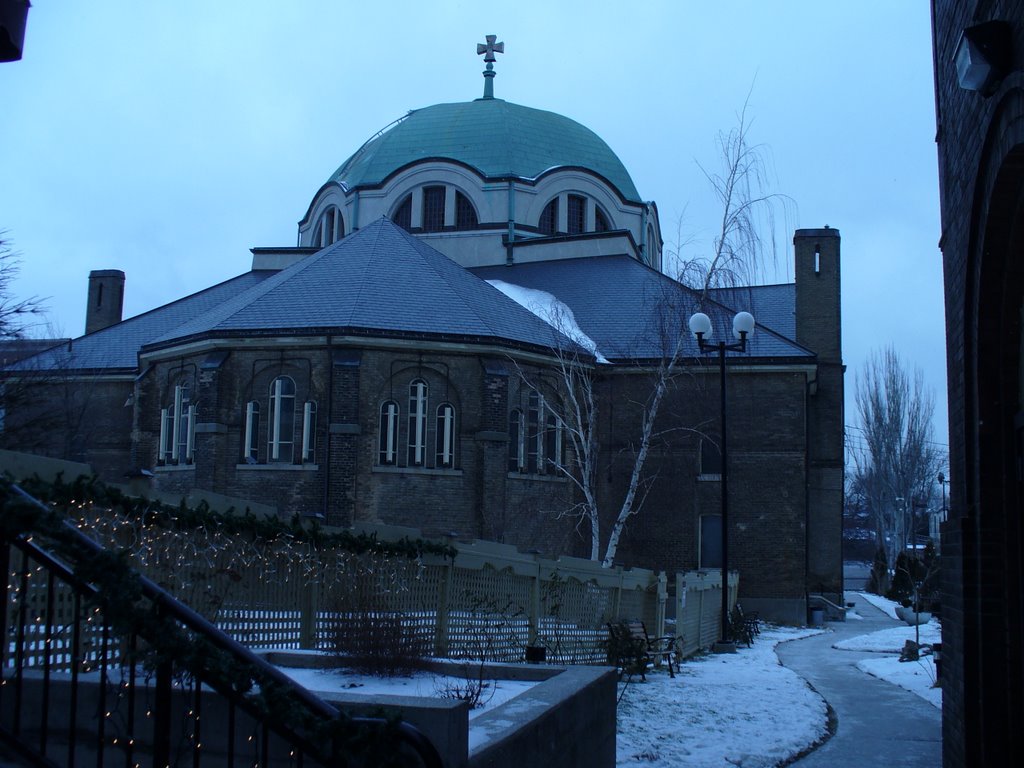
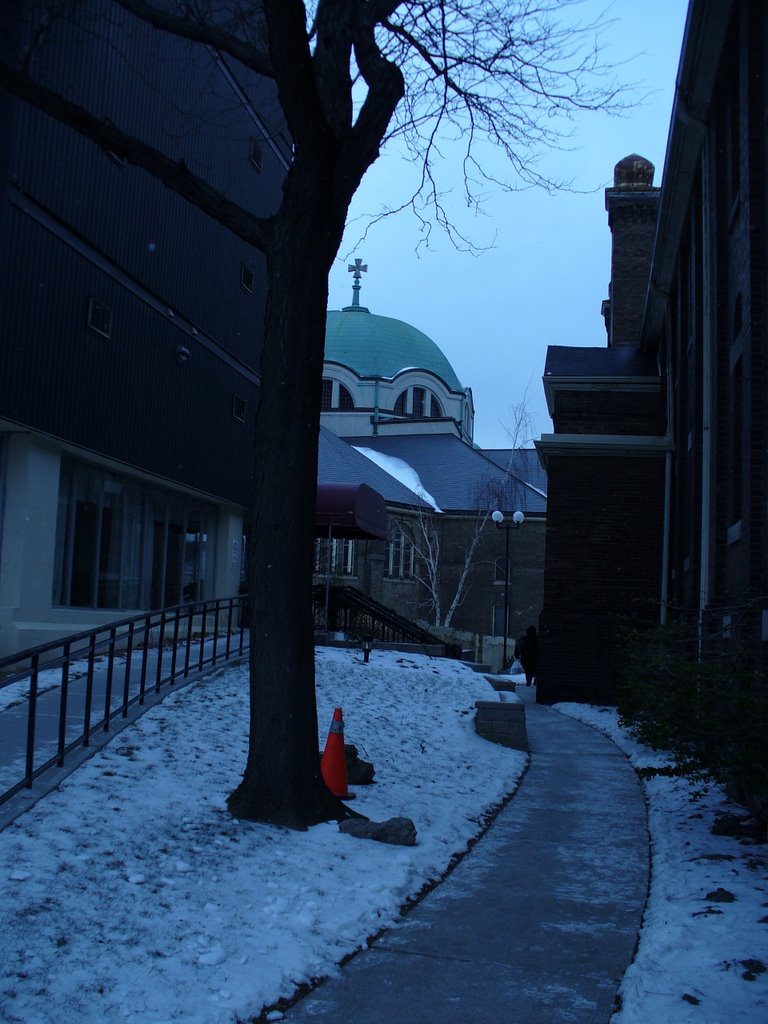
For all of our good friends and devoted readers who spent part of their life reading that last, long post--a break! In typical Yvana fashion, I'll be right to the point with very little flowery language, and focus on the update. With pictures! (To the left is a picture of the last part of our walk to church on Sunday mornings--the week after the snow one we posted about. Of course, straight ahead is our church--in the Byzantine style. On the left side of the picture is Saint Anne's Place, a retirement community, and on the right is an enormous building with a theatre, a fellowship hall, and other rooms that we rent out to drama groups etc.)

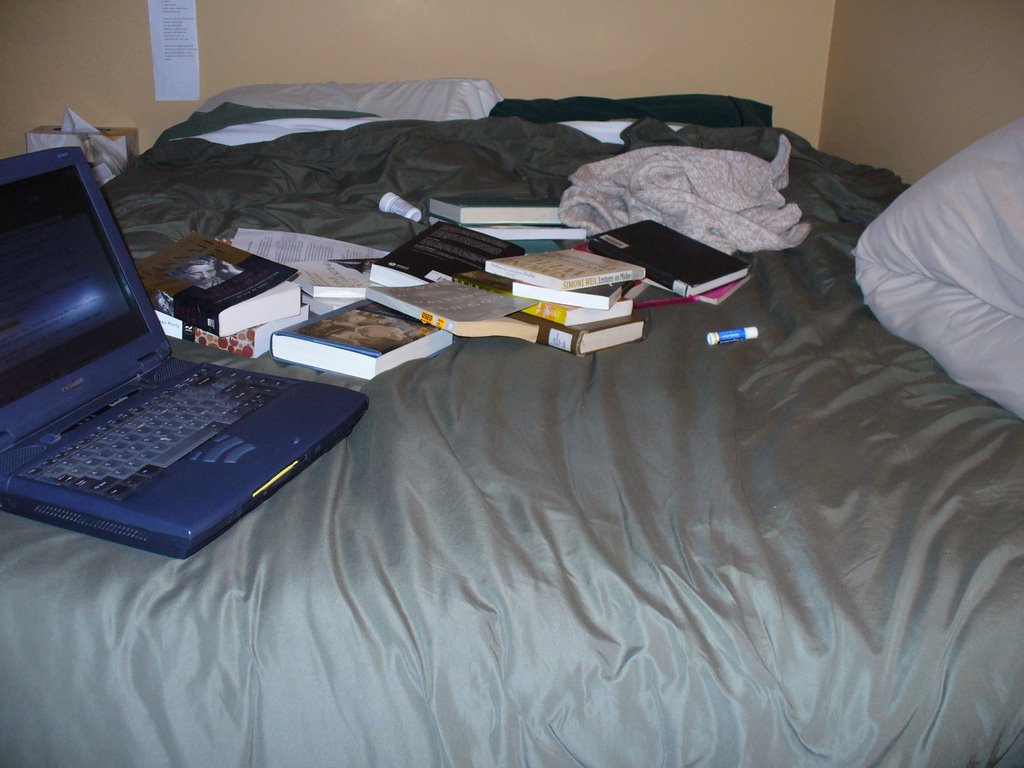
As many of you know, our grad school (ICS) gives students 6 weeks after the completion of courses to complete their course papers. 6 weeks after courses was two days ago. This means, the last few weeks have been pretty intense. Not only are we reading for current courses (and, for Mike, still working on Latin) we are also trying to finish thinking about classes that ended over a month ago. In addition, since one of our courses this last fall was a guided reading which results in our thesis proposal, we also had to be thinking a whole lot about what we were writing for our theses. Anyway, with how orderly Mike is, he works well at a desk, to have all of his books/papers/coffee laid out nicely. I think it is a picture of how his mind works. If this is true, though, what does this picture of my workspace on our bed (right) say about how my mind works? This was taken after 30 hours of nearly un-interuppted time writing and thinking about my thesis. (yes, I did sleep, but I moved the books for that!)

[Because points are fun, and Sara started this trend, I'll give a point for every unique book you can name from the chaotic mass--I know there's a couple obvious ones--those are just freebies for the first viewers... Maybe I should give more points for anyone who can see the connections between these books... Of course then points would just turn into thesis help for me--not a bad idea!]

Of course, coarse course papers aren't the only things we have been up to since we have been back in Canada. We are continuing many traditions, one of which is continuing to attend St. Anne's Anglican Church. It is a short walk from our apartment, and we have been attending there regularly since last October. It is on the list of historical sites in Toronto, which--though you can't see inside, in these shots, is plain enough to see why. If we had a picture of inside, you could see some of the paintings of the group of seven--before they were famous.


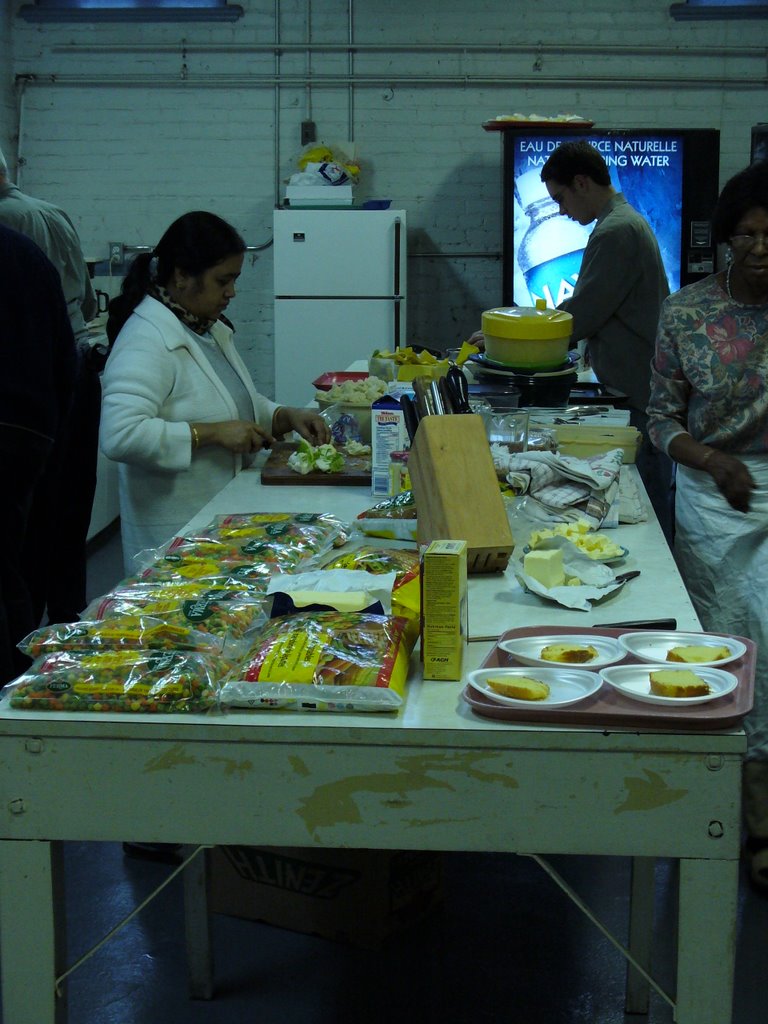
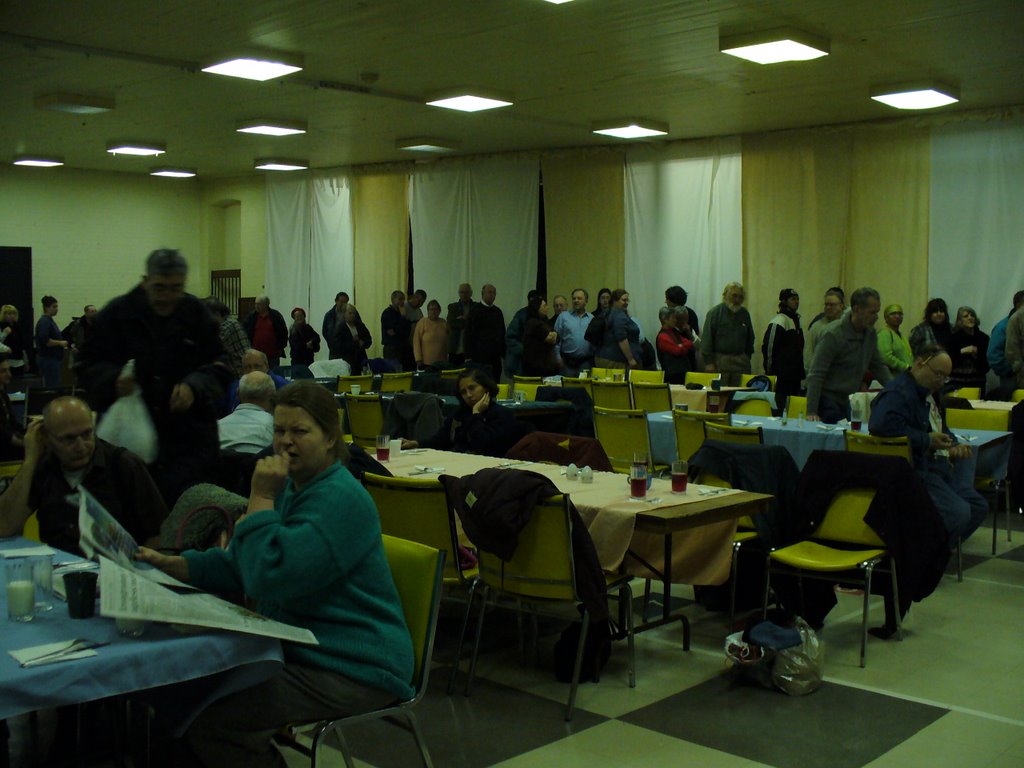
We also help out with their community dinner. The people from the church offer a free, hot meal to needy people in the community once a month. So, last Sunday we were chopping potatoes and cauliflower, making coffee, serving desserts (see Mike at left) and fellowshiping with our fellow parishoners and the people that came in from the cold. We had quite a group this past Sunday!


We have also been savouring tea (Thanks again, Paul!) in our favorite mugs--a short and stubby one for Mike (we bought this at a thrift store around the corner for 75 cents, and then we saw it at the University of Toronto for $13CDN!), and a tall and skinny one for me :) (unfortunately this belongs to the apartment, so it won't be ours for too much longer...)

So, that's what we have been up to, in brief... On the docket for this week: Gilbert and Sullivan's *The Grand Duke*--I doubt we'll get pictures, but it should make the next post a little more interesting!

Thursday, January 25, 2007

Cleaner

Most people give a sporting chance to the idea that you shouldn't pre-judge people based on the small amount of information you know. Even if they don't, they pay lip service to it for the sake of our current cultural climate. Overall, I think this is good, and many people I have met have a certain sense of consistency one way or another-either they give everyone as fair a chance as they are able or they give everyone a once over and come to a conclusion about them that could take years, even decades to seriously challenge. In reality, there is nobody in the first camp, since there is always some process of sizing up another person when you meet them. This occurs before you have any sort of extensive information about the actual individual, since this is often based on past experiences or habits passed on from a previous generation that may or may not be applicable to the current situation.

This unavoidable process of sizing someone up may be the nearest thing humans have to what you might call an animal instinct. It acts a bit like scent does for a dog, although thankfully we don't have to circle up and nuzzle each other's behinds. Certainly this instinctual judgment is helpful in many situations since there are times where you have to act without all the facts, but often this flares in surprising ways. For instance, when walking to the grocery store, I assume that when I pass a hunched old woman wearing a babushka she won't suddenly turn and attack me with a flaming trident: a legitimate fear based on a freaky dream I had after watching Best of the Best 4 one night, although it seemed to have nothing to do with that movie. Justified or not, I give the old ladies a chance, for one reason simply because if I carried a daikatana around to defend myself I might get arrested, or more likely cut some appendage from my body. Aside from over the top neuroses I still make quick and often unfair judgment calls about people that may or may not be true that invariably prevent a good relationship from developing from the get go.

I think about this in connection to something that happened before Christmas. I was looking for a relatively inexpensive dry cleaner to care for my suit and sport coat, both of which badly needed refreshment. After three years this would be the first time my suit would receive such treatment. I decided that after a wedding last summer, when I spend most of the evening dirty dancing while slightly intoxicated with my friend Bob, it needed some loving care to restore the fabric to a respectable level for a Christmas party. My sport coat was in a similar situation, since I wore it far too frequently and often used it as a second layer while riding my bike to school. It acted like a veritable sponge for bodily secretion and would have made bloodhounds turn up their noses if anyone ever needed my scent to track me through the wilderness. So I looked through the phone book to find a place close to school where I could have my ripe outerwear get a good cleaning.

After an extensive search of approximately two minutes I found a shop close to the Institute. When I gave them a call, what quite possibly was a man answered the phone with a guttural sound. Momentarily phased, I asked how much it would cost to dry clean a sport coat, completely forgetting about the suit since only the coat was within olfactory range. A response that I took to mean eight dollars followed, to which I asked how long it would take. Some muttering, then nothing. I asked again, and almost immediately I heard a shout that was probably “one day,” but I couldn't be sure. After I hung up I felt a bit uneasy about the whole thing, but I felt obligated to patronize this shop since I had extended the digital handshake of a phone call.

As I biked down College St., searching for the address, I felt myself dreadfully propelled past a bevy of slick, professional looking laundry and dry cleaning shops. I maintained the hope that the address was for some kind of professionally managed garment service I had never noticed before. This was unlikely since I have driven the length of this road innumerable times for over a year. But still, I pictured bright, polished linoleum, stainless steel, and the buzz of automation hovering in the air. To me, these things guaranteed rejuvenated clothing that would actually look better than when they were originally purchased. Perhaps even the wear on the elbows, missing button, and frayed cuffs of my sport coat would be miraculously healed by the expert clothing professional, looking not unlike my vision of a domestically oriented Jesus.

When I pulled up to the correct address, I knew this would not be the case. It was a dilapidated building housing an even more dilapidated shop, with a yellowed, partly illuminated sign cleverly announcing to the citizens of Toronto that in here there resided simply a “Cleaner,” unlike the other places I passed that offered, “Expert Cleaning Services,” “Suds and More,” or “Dry-Cleaning with Care.” I couldn't even see through the stained and dirty windows as I locked up, and I wondered how I could trust my precious coat and only suit to a place that couldn't even keep itself fresh and squeaky. As crestfallen as I was at that moment, I looked down the block to just catch a glimpse of the last place I passed that looked so much nicer that his one. I came close to turning back and declaring to this place, “launderer, clean thyself.” But I didn't.

Immediately inside the door was a short flight of stairs leading to the main floor of the shop, which was about three feet above street level. At first, I wondered if my glasses were fogged or had a smudge, since things seemed a bit hazy at eye level from where I was standing. But after I removed my glasses the haze remained, and I wondered if there was some malfunction with a machine that was causing a bit of smoke in the shop. This did not bode well. But when I took another few steps into the shop this fear was dismissed in favor of a new one, for I was overcome by the distinct smell of cigarettes. There was a man at the front counter of the crowded room with one in his mouth and another in an ashtray, both burning away. Since it was a one room business, I saw a small old woman just behind him operating what looked to be a large ironing machine. Beside her was several racks of clothes, all engulfed in a cloud of tobacco. As I was walking up the stairs into the haze, the old woman started shouting in a language I wasn't familiar with. She was pointing to the slacks she was working on, and the old man replied with a guttural noise similar to what I had heard on the phone. He went over and picked up the pants and after he held it inches from his face, since he seemed to have failing eyesight, he started yelling and threw it into a rumpled pile on the floor. The woman shrugged and reached for another pair. As the man came back to the counter I noticed a large sign on the wall, which stated in no uncertain terms that the business would not be responsible for any damage to clothes while in their possession. This did not make me feel good in light of what I had just seen. Where was the shiny metal? Where were the cleaning robots? Where was Jesus? There were just crazy people here; why should I trust them?

But I silently handed my suit and coat to the short, half-blind old man who I assumed was the manager and resident dry cleaning expert. After I stroked them fondly one last time, the man gave me a small sheet of paper scribbled with indecipherable symbols, followed by a verbal injunction that probably meant that these would be done by this time tomorrow. I left with a meager wave.

If I ever saw them again, I was sure both would be irreparably damaged, or at best smell like smoke until they underwent some expensive form of nicotine detox for the addiction my fabric would have developed from its time in the shop. Maybe this guy had it in him to be a good cleaner, but all signs indicated otherwise. I felt like I had placed my trust in someone entirely unsuited to the task, even if they were a nice person. I felt like I had inadvertently placed my faith an armless mountain climber. Now I simply had to wait for the assured failure, tangibly resulting in my ruined clothes. My anticipated loss of possessions caused a number of reactions based on what I knew. I knew that cigarette smoke stinks up clothes, so I pre-blamed these smokers for what I knew would happen. I didn't know what goes into the dry cleaning process, but if they were apparently incompetent in something as simple as properly ironing pants, something I could do, how could they carefully clean my suit, which I couldn't? This amounted to funding gross incompetence. I anticipated a lot of things, none of them good.

A day later I walked to the shop from school, dreading what I would find in return for my fifteen dollars. When I entered, the cloud still encircled the counter, and the man still said nothing when I handed him my ticket. The old woman in the back was gone. He shuffled over to a rack and pulled out two bags, immediately handing them to me. I paid, then scooted out to the street where I could inspect the damage without actually having to confront the keeper about it. To complain about and ridicule him behind his back seemed like a much more civilized approach that actually trying to talk to him. I pulled both articles out under a bright streetlight on the corner and looked for the damage.

Nothing. Nothing but crisp seams and the familiar tight weave of the fabric. All the buttons in place. I smelled them everywhere, searching for the clinging smoke I knew would be there, but could sense nothing. Nothing but clean clothes. No smoke, no body odor, no overpowering chemicals, no ashes. It was a perfect job.

Oddly, there was no immediate relief from all the anxiety I had stored since the beginning of the whole affair. My climber had somehow managed to gnaw his way to the rocky peak, yet I was not relieved. I realized that in my mind I had snowballed this whole event into an uncalled for insult to this man and his business. I had no knowledge of anything involving dry cleaning or this man's business, but accused him of incompetence based on my own expectations, funded by my limits and fears. I expected linoleum, robots, and my own personal Jesus, and was angry when I got a man. This was shameful.

But I was also hopeful. Maybe this whole episode would put some sense in me and show me that people can be surprising no matter how many expectations we place on them. Maybe I was cleansed from a few of the prejudices by this small, half-blind, chain smoking old man. It was a very small even when put into perspective, and really, I only got what I should have expected had I been reasonable. But just maybe this would in a small way change the way I looked at some people.

Then I saw an old lady in a babushka pass by. I tensed up for just a moment and, after nothing happened, scurried back to school.

M

Tuesday, January 16, 2007

Three portraits of Winter’s First Snow

1.

Sunday we woke up to the gently falling snow, covering the earth with a beautiful, clean blanket. After getting ready, as we walked to church and then especially as I walked home alone with my reflections, I remember thinking: “I have never before been so happy to see the snow.” Well, maybe I was this excited after moving from California to Chicago for my first real snow ever, but this was right up there with it. Don’t get me wrong—as a California girl, I was delighted to be able to wear a windbreaker on US Thanksgiving, and to have no need for bundling up, even through December. But I think it hit me on Christmas break, when we were in Iowa with the gray and gloomy mud-causing rain—I wanted the clean covering that a fresh snow gives. What a beautiful sight!

On Monday, the beauty and the bliss were a distant memory. The radio woke us up to: “the roads are clogged, everything’s closed, public transit’s slow, its –10 (Celsius, that is) with freezing rain right now turning into freezing with some other kind of precipitation later in the day. We can laugh at you now because we are here in our warm studio, since we had to be here by 4 a.m., so stop your whining and get out of bed.” Good Morning! Realizing that throwing the alarm clock on the floor and rolling over in bed was not an option for either of us this Monday, we grudgingly got up out of bed to face the horrors. Not only was the precipitation very different (I am hard-pressed to think of a poet who could, in good faith, praise freezing rain or the descriptive ‘ice pellets’), but Monday brought no Sunday walk to church. We were going to have to choose our bikes, risking life, limb, and equipment, or to pay for (and also risk) the sardine can that is public transit. After wedging ourselves out of the subway car and walking through the “rain,” I noticed some bike tracks, that’s for sure. But there weren’t many of them, and, Thank God, they weren’t mine.

2.

When there is a snowfall I begin to notice the particularities of a Toronto approach to life. In the U.S. we have a well-established ritual surrounding severe weather, or really any type of weather at all. Before the skies are even so much as cloudy great fleets of monstrous vehicles appear, pre-spreading salt and sand should the snow be sneaky and come from the ground without the warning of cumulonimbus formations. Media coverage is essential, because it isn’t truly a crisis without a good dose of sound effects, flashy graphics, fearful statement from local officials taken way out of context, and suffix statements such as, “of the century,” “of the decade,” or at least, “of the last 5 minutes.” These things are all done in order to get the suburbanite out of their couches in sufficient time to swamp their local super store in order to buy silly things like snowblowers, Bud Light, and canned rutabaga should people become stuck in their homes or cars due to the massive amounts of traffic entering and leaving local Home Depots or Walmarts. This is quite honestly the only way stores can move their stockpiles of snowblowers, Bud Light, and canned rutabaga. They are thankful for the opportunity since stores are required to carry these unpopular items due to a FEMA mandate. When the snow actually does come, politicians make appearances and say things. Years ago, Chicago had some snow and Daley appeared without a suit coat and his sleeves rolled up on WGN that night (the Tribune and Sun-Times the next day), apparently to prove that he was hard at work bribing the snow with lucrative alley paving projects in return for the menacing precipitation to “just go away.” He did truly order an unprecedented number of plows and jockeys to curb the crisis, and these crews corralled the snow into massive piles throughout the city in the process burying mini coopers, lower Wacker Drive, the city budget, and other snow crews. These crews remained in suspended animation Han Solo style until late the following October, when they emerged and voted Democratic along with a dozen of their closest dead relatives.

They do things differently here in Toronto. During some inclement weather I was able to observe the response which, to my knowledge, included no plows whatsoever. To include snowplows would be a drain of money away from more important pastimes such as building new corporate arenas for the Maple Leafs, constructing superfluous subway lines, annexing neighboring cities, and elections. As the snow begins to fall here, the City of Toronto promptly deploys masses of kindly volunteers in official looking caps to stand at the corner of major intersections and politely ask the snow to refrain from loitering on the roads and sidewalks. You won’t find a volunteer on a corner with a bank, since everyone knows that if you come within 5 meters of a BMO or CIBC you will be automatically charged 12.50, and quite frankly snow can’t afford that, or the volunteers. But even though they are good sports the volunteers fail, at which time the city utilizes their backup plan. They send out three to five pickup trucks with the mandate to drive along major roads while honking at people and telling them to go home and watch Corner Gas. This usually has no effect, so the snow stays on the roads and freezes into treacherous ruts for the rest of the winter. The government is learning from its past failures and has constructed something called the PATH, which is an underground collection of un-navigatable passages in the financial district lined with perpetually closed stores that apparently sell many different types of chewing gum. The goal of PATH is to get you very lost and frustrated, and to make you more thankful when you do get back out onto the snowy streets.

3.

In the Mols household, our approach to hazardous meteorological situations has proactively developed into staying at home and writing about what they make us think of.

Wednesday, January 10, 2007

Reflections on resolving not to resolve

Looking back on the new year, more than a week in by now, I find comfort in my shift of practice. Though not conscious of it at the time, I can see now a definitive move to resolve not to resolve this new year. It may not have been fully intentional, but I find it significant all the same. Often the new year brings untold anxiety for me—mostly centering around my desire to “be a much better person this year!” How ironic that this compulsive anxiety was what was truly keeping me from being the “new and improved” person I wanted to be.

So, what was different this year? What was it about this year’s turning that gives me more peace about the coming year? Probably a lot of things but in keeping with my focus on simplicity this year, let’s just say it has to do with resolving not to resolve. Actually, since it was unconscious I should say it was just not resolving period, but the other way sounds so much better… So, my experience with the new year 2007. I can’t really describe it so much a give a sense of the feeling of it. Mostly, I was tired. And not just sleepy-tired (though I was that, too). I felt body and mind and soul and talking tired (see below...). I was tired of being anxious about PhD applications, tired of working out how we were going to see all the people we wanted to see over Christmas break, tired of thinking about papers and the looming thesis; tired.

This year I didn’t want to add to that tiredness by focusing on all the things about myself that I wanted to change(I think especially of a dark new year’s, in my late High School years—and the panic that I felt when I realized that just a day into the new year I missed the marks that I had set for myself…). I just wanted to stop being tired—including all the being-anxiousness that made me tired in the first place. Instead of constantly thinking about my need to cease undue anxiety, I just stopped. I started living more intentionally, something I had begun doing before the new year, and therefore something that didn’t have all the hang ups as a “resolution” would have had. Anyway, I have been more at peace—and as I fall short, feeling anxious again or wanting to be more in control, I just hope for a better response in the future.

Enough (way too much) about me. There are a couple ways that I have come to think about this shift of perspective. One I heard on the radio a couple weeks ago and stuck with me, and the other one I heard in class on Monday. I think both contribute to a fuller understanding of this phenomenon.

First, the story on the radio. Flipping through stations we ran across a book review from this woman who wrote a book about her experience of quitting smoking. Her first “last cigarette” was a dramatic one—surrounded by pomp and ceremony. Her real last cigarette is hardly remembered—there was no ceremony around it, making the quitting more a growing in a different direction than a focus on what you are leaving. See, she shifted her fixation from what she wasn’t going to do anymore (smoke) to just going about her life—putting off her cravings by waiting, and waiting and waiting, till she didn’t really even crave it anymore.

It is indeed difficult to change the categories in which we think. The example from class yesterday about the body in the history of thought may be a paradigm example. To oversimplify (and try to stay in understandable terms!), Descartes reacted against the body-SOUL split that he perceived in ancient and medieval philosophy/history by introducing a new (well, in one sense) term—the MIND. Of course, however, through his new articulation, as well as its application in later philosophers, the MIND didn’t get past the duality that it was intended to, but rather only replaced the SOUL as the privileged term to the body—once again suppressing it. When post-structuralists determined to leave the body-MIND duality, they centered on language as the third and ultimate term—doing away with the split. Predictably, however, this new term also fell into a dualistic trap, replacing MIND, but also being the greater term in relation to the abstracted/unreal body.

In other words, it is not so easy to transcend a dominant paradigm by adding a new term or a new resolution to the equation. By focusing on what needs changing, we fixate on it, and end up—usually against our will—moving in that direction anyway. We cannot move forward in the direction of our hopes while our attention remains fixed on the pitfalls to either side.

So, what does all of this high language really mean? I think it is indebted to Simone Weil’s (of course it is!) notion of attention. Indeed, the direction of our attention is the direction of our movement. Think not to what you have resolved against, what one is leaving behind but rather the hope for what is to come—thereby making the steps clearer and straighter as you grow forward.

Monday, December 18, 2006

ICS (Chris)tmas Party

They say that a picture is worth a thousand words, so in our blog we will be posting the equivalent of all of our course papers for the semester (if only it was that easy...). We also figured that you might not want to hear what we might post this week, since we have been working on said course papers all week and might inadvertently blurt out a sentence containing more than 40 words that are the size of your right leg. Actually, that last sentence may be a great example of that... On to the pictures.

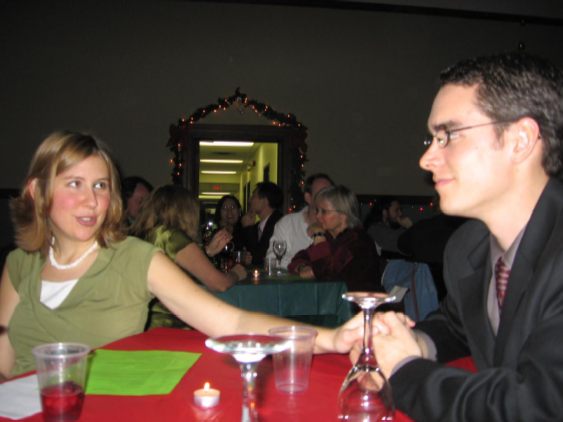
What will we be seeing pictures of? Well, funny you should ask. ICS just had its annual Christmas party last Friday, and one of our friends brought a digital camera--hip hip hooray! So, you can have the insider scoop of what Christmas is like at ICS. The first big one is Mike and I before the party--excuse my funny talking face, I guess that spontaneity is just what you risk for catching a tender moment...


First of all, there is mood lighting and decorations. Our good friends set up all the little christmas lights, and filled the centerpieces, and lit the candles, prompting it to look so VERY trendy and chic on the fourth floor of 229 College Street. Wow--I think the blurryness makes it look even more exciting, don't you think?


Then, of course, there is alcohol. But, my friends, this is no ordinary wine. Jeff, Chris and Mike are drinking nothing but the finest homemade Borolo that you can find in Ontario. I know, because I made it. Ok, they picked it out (and then told me that it was Borolo instead of what it really is--Barolo), but I got to bottle them right before the party and affix the fancy label you can see in the picture ( I love rubber cement!). The "V" you can see stands for our wine-making crew, "The Five philosophers" as well as the first letters in our title "Vino Veritas" Oh, it is so chic!


And then, of course, there is the entertainment. Chris is a fantastic guitar player, but I can't tell you about his ivory-tinkling abilities because this picture was taken later. But it is a fine picture of our MC, doing something not-really-MC like. The real entertainment was legendary, so I guess you'll just have to wait to hear about it as the legends go! But seriously, it would be impossible for me to tell you about it--it was the entertainment that can not be named...


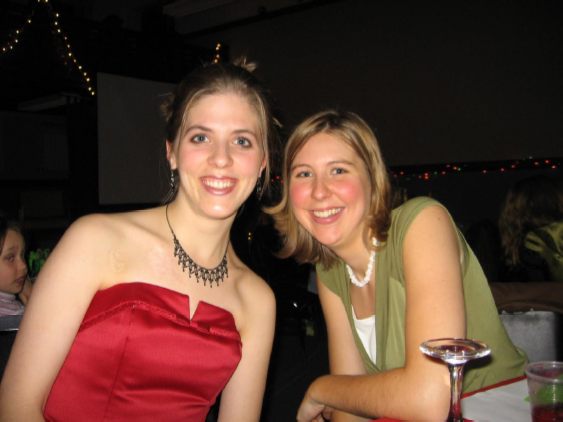
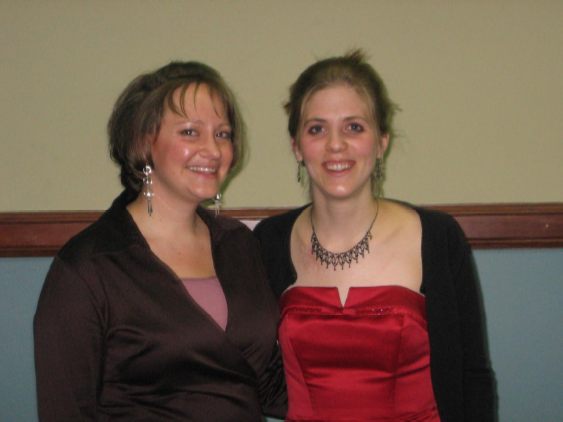
And who would stay at a party without any friends? Here is a picture of Me and Sara, and then of Mike, Jeff and Chris, once again. Though the mood lighting is gone (they turned on the lights to clean up afterward), here is a less-ambient picture of Sara and Lorraine--the one behind the camera for most of the shots. So often we just see each other in "school clothes" that it was great to be able to have an occasion to dress up. I think we all rose quite well to the occasion! Don't we all look great!?


Finally, the afterparty--Back downstairs in the ICS kitchen. Clean up is over and none of us wants to say goodbye for Christmas break. We had a good time, as you can tell... Need I even say--Our very own Critty-Boy...(Chris, that is...)

Monday, November 20, 2006

Journeys

I was asked last week to give the reflection at our school's "Wednesday Worship," and since it was an autobiographical reflection about my academic journey, I thought I would share it with you as well.

*******************************

When I was asked last week to reflect autobiographically about my academic and faith journeys, I thought it would be pretty straightforward. Afterall, I have been thinking a lot about this recently in preparing applications, and journey, as a metaphor, is fairly rich. Or is it? Before beginning, I want to be careful to qualify my growing understanding of "journey" as a metaphor, both because I believe it is on the verge of becoming too trite and overused, and because I am coming to a deeper understanding of it.

"Journey" has always connoted to me an active movement from A to B, but with the added benefit of also appreciating the in between, the "getting there". I feel like this is a far too simplistic understanding, however, that needs further unpacking and qualification, since I have been growing, recently to a more richer understanding of journey that is not nearly so active (in its traditional sense). This more difficult understanding of "journey" which is maturing in me, puts emphasis on the meaning-laden pauses, the patient waiting, the sinuous detours, and the attentiveness to the surroundings that you can only get by stopping. I want to be careful to say that this understanding of journey is active, though it may not be physically so. The reflective work that is necessary in these pauses is significant and should not be minimized. I say this is a more difficult understanding of journey for me because, for those of you who know me-I am very concerned with the "getting there," and have been of the mind that any hesitation or sidetrack should be seen as a result of my fallenness or my inability, and therefore minimized or suppressed.

I suppose this understanding of pauses as sinful comes in part from a simplistic reading of the exodus-that the wandering in the desert was purely a result of Israel's sinfulness. If they had only been less whiny, better listeners, more obedient-they would have been enjoying the milk and honey so much sooner! I think now, however, that the exodus-spanning several books of the Older Testament-can be better appreciated as a meaning-filled pause, an encouragement to not be so worried about "getting there" that one misses the significance of "being here."

One such passage from the Exodus story is particularly striking in this regard-it comes just after the Israelites fled Egypt, crossed the Red Sea, saw their captors drown, and had a party on the banks. I can imagine that they have an unbelievable amount of momentum for their journey-a kind of "what are we waiting for, let's get to the Promised Land" attitude. But no. Right after "the horse and its rider God has hurled into the sea" comes this story:

Exodus 15: 22-27

"Then Moses led Israel from the Red Sea and they went into the Desert of Shur. For three days they traveled in the desert without finding water. When they came to Marah, they could not drink its water because it was bitter. (That is why the place was called Marah.) So the people grumbled against Moses, saying, "What are we to drink?" Then Moses cried out to the Lord and the Lord showed him a piece of wood. He threw it into the water, and the water became sweet. There the Lord made a decree and a law for them, and there he tested them. He said, "If you listen carefully to the voice of the Lord you God and do right in his eyes, if you pay attention to his commands and keep all his decrees, I will not bring on you any of the diseases I brought on the Egyptians, for I am the Lord who heals you." Then they came to Elim, where there were 70 palm trees and they camped there near the water." (NIV translation)

Instead of moving right into the promised land, the Israelites had to wait. God was to test them, it says, though it wasn't specified whether this was just for this moment, or whether it could encompass the entire desert wandering (or even more!). But God would also heal and provide for them. This was to be a meaningful pause, a patient waiting-taking time to appreciate the "being here." This passage comes to me as such a gem-right in the middle of the desert at the beginning of their journey to the promised land, God provides the Israelites with Elim-the place of large trees. The desert isn't just something that is to be hurried through to get to the other side-the Israelites had a lot of growing to do as God's people before they got there. While not always pleasant (could these large trees be on a white sandy beach instead of in the middle of the desert?!), God still promised to provide for them in the waiting.

What I find especially striking and a bit ironic about this biblical waiting, is how it coincides with one of my own meaningful pauses. After college graduation, full of momentum (escaping Trinity Christian College; crossing the graduation stage; having a big party... doesn't this sound familiar?), I found myself in a humbling period of extended unemployment, with no promising possibilities in my field of teaching. I wanted to go to graduate school, but it wasn't the right time. I found myself needing to wait, though I wasn't patient about it, and at the time, it didn't seem very meaningful. Interestingly, I found myself, like the Israelites, at Elim. Though not quite the picture of palm trees and waterfront property that the Bible makes out, this was Chicago, afterall-it was a job. My time at Elim was very much still a time in the desert, though there was a providence in that desert that I could hardly see as anything but graciousness. It is striking to me looking back, how I interpreted ironically the water and the palm trees that was on Elim Christian Schools' sign. This was no picnic year for me. But maybe it was the year of reflection that I needed in order to get ready for the next step. I have consistently resisted calling this year of working with boys with autism a "year off," as is typical language for people in graduate school who don't go "straight through." However, I am still in the process of truly appreciating my year in Elim, in finding the meaning in the pause, in being grateful for the "being there."

I feel so painfully slow in learning my lessons. Before fully comprehending the meaningful pause that was my literal Elim, another, figurative one is upon me. While I am still in school, and there has been no pausing to speak of in recent history-the uncertainties of the coming year are looming large. Elim Christian School is miles behind me, but I am once again in a place where I must wait patiently upon decisions and live faithfully in the "being here." I am not yet ready to go on to the next step in my educational journey-that is for a time that is yet beyond me, maybe next fall and maybe later than that. Right now I must do all that I can to take advantage of these moments of reflection that PhD applications have been granting me, and continue till completion the journey already before me.

Forced or chosen-there are numerous opportunities in our daily lives to benefit from meaningful pauses. I am still learning to rest in God's providing and the assurance of God's testing. Will it be in my current "Elim" that I rest in the shade of the palm trees near the water? Or will I miss this meaning-filled pause on my journey? Will you?

***********************************

Since I do much better extemporaneously than I do with a manuscript in public speaking, this is a rough summary of what I said last Wednesday. I did like that after my reflections we opened the floor for everyone to share about their meaningful pauses. I would love to hear how you all reflect on difficult times in your journeys...

Friday, November 17, 2006

Christmas Flood

When you live in a basement apartment, you must accept certain risks. One of these is that in times of heavy precipitation you may find that some areas of your dwelling will develop a certain level of saturation.

It rained a lot one day, but this particular risk did not come to our minds. After a busy day, Yvana had nothing on her mind aside from getting home in one piece while attempting to slip through bouts of rain, both of which she accomplished. I was thinking about making dinner, about what I was reading, and about my upcoming meeting with my adviser. This meeting was causing me a fair amount of anxiety, mostly because I secretly get anxious about everything. Usually I conceal this through outright denial. But that day I chose my fallback: procrastination. So I prepared cookie dough instead of completing my report essay.

The rain had just started up again when Yvana was a block away, but this was just the light precursor to the downpour that started after she was inside. I had expected her later, so I began the fried rice-making procedure when I heard her keys at the door. The eggs were scrambled in the oil by the time her helmet was on its shelf.

We exchanged our stories from the day. A stressful experience on the phone. Good seminar, but concluded a half-hour late. Copied readers. Success in returning a bicycle pump. Failure in replacing a watch battery. Dinner was now ready, and shared in the spaces between conversation.

We preheated the oven for the cookies. When the first batch was coming out, there was a knock at the door. Our landlord wanted to see if there was any seepage in some problem spots since it had been raining most of the day. Yvana showed her around as I prepared the second batch. No leaks by the furnace, and I had successfully banished my upcoming meeting from my mind while resisting the urge to sample the batter.

Yvana was leading the way to the bathroom inspection when the sheet was in the oven. I didn't think there was much I could contribute to the situation, so I stood in the kitchen and read the bank statement we had just received.

They were finished with the bathroom and were moving into the utility room while I attempted to understand why, “As of November 30 Citibank will no longer offer World Wallet Drafts for purchase,” was under the Suggestions and Recommendations heading. I heard some commotion in the front of the apartment as I searched for the promised “more information listed on this statement.” Stymied. This didn't seem to offer any recommendation, while the suggestion seemed to be too vague to be of any good. Finance mystifies me. I wondered the context of this bank statement would count as some kind of Wittgensteinian private language game.

Just before the timer called out, I noticed Yvana and the landlord taking things out of the closet and placing them in the hallway, followed by some kind of exclamation. I scraped the cookies off the sheet bitterly—they were flat. I had mixed the dough when I got back from the coffee shop, so it had sat for several hours before baking. That probably did it.

When the last batch was in the oven most of our belongings, formerly in the utility closet, littered the hallway and bedroom. The landlord offered some apologies, then ascended the stairs to get some towels. She scattered them around the closet, then left with the cookie we offered her. The last batch of unleavened baked goods was out, and I finished washing the dishes. I sealed the cookies up after they were cool enough, hoping to preserve what moisture was still in them.

We assessed the damage over cups of tea—peppermint for Yvana, orange pekoe for me. Most of the stuff we stored was in plastic bins, or on makeshift shelves. We had some experiences last year with this same location, so we were prepared. The only thing that sustained worrisome damage was a cardboard box full of Christmas decorations. We steeled ourselves for the worst, and opened the container.

The leak in the closet must have been fairly recent. Although the outside of the cardboard was soaked, it had for the most part not touched the items inside. We aired them out for good measure.

As we removed the ornaments, we realized that we had not seen them for two years, since we have never had a proper Christmas tree on which to hang them. They were mostly Yvana's. Her relatives had a tradition of giving ornaments every year, a tradition that began the year her sister was born and continued to the year we were married. She had memories attached to each one, some more significant than others. One was labeled as a gift from her great aunt just before she passed away. It was three winged humans holding hands around a star. On one side, the hands of one figure had broken, creating a rupture in the circle. Yvana reminisced.

“She was Catholic. I never understood why she only had one kid. But my uncle was protestant. So there you go.”

The only ornaments I recognized were the ones we received in 2004. Thin, crystal things with, “First Christmas Together” etched in calligraphy. I tapped my ring against one. Thin, plastic things with, “First Christmas Together” etched in calligraphy.

“You're going to break them.”

“I did the same thing to your ceramic “Precious Moments” one and it was just fine.”

“Well, you'll break those too.”

I held up an ornament consisting of a snowman's head attached to a string.

“We should start a snowman theme.” She glanced around the collection, noticing the snowman paraphernalia scattered on the floor. “I guess it's already started.”

I turned back to my snowman head.

“Somewhere, there is a decapitated snowman wandering the aisles of a Hallmark store.”

She laughed. As we sat on the living room rug she explained that she would line them up in chronological order before she hung them every year. We ordered them accordingly, and as she explained the significance and story surrounding each one I lost interest around 1993. Glancing at the bookshelf I noticed my copy of The Oxford Illustrated History of English Literature. I pulled it off the shelf and opened it to the entry on Muriel Spark. I began to read. Yvana graciously overlooked my rejection, and started to go about the process of gathering the undamaged ornament boxes.

“Is there a small box for these?”

There was no catalog of our empty boxes in my memory. I wondered why she couldn't get up and look for herself. I was working my way back in my gloss of English literature and had already reached Forester. She looked at me with her hands full of ornaments when I grunted in response to her question. She asked it again.

“No.”

“So what are we going to do with these?”

I was perfectly enjoying the moment I was having with late 19th century novelists and didn't understand why she had to keep pestering me.

“Don't you have a report to write anyway?

“...”

“Mike, is this really the best use of your time?”

I felt blood rush to my throat, which I should have known was a bad sign. I set the book aside at George Eliot.

“Why can't you get the box?”

“I thought you said there was no box.”

“To my perception there was no box. Do you see any boxes right here? I don't know what we have. You know where we keep them. Why did you have to ask me?”

She stared at me incredulously.

“I figured you would help.”

“Well, I thought this was a poor use of my time.”

“Fine, we'll leave them here.” She got up. I had every intention of continuing the argument. I have found that sometimes doing what it was that was asked of you before the fight began needlessly escalates the situation. So I grabbed a box.

“Mike, I said just leave it if that's how you want to do this.”

“Fine.” I dropped the box in the middle of the room.

I stalked back to the desk, picking a path through the Hallmark and Precious Moments figurines littering the hallway, and attempted to resume my reading of Jean Leclercq on Bernard of Clarivaux. Page 169 of The Love of Learning and the Desire for God contains a quote from Bernard where he is explaining a passage from the Rule of Benedict.

“Then come the spiritual gyrovagues: their inconsistency carries them from reading to prayer, from prayer to work, preventing them from obtaining the benefits of their undertakings: stability in effort and perseverance in devotion. Victims of acedia, they think it better at one moment to do one thing, and, at another, something else; they begin everything and finish nothing.”

I looked back at the ornaments on the floor. I smelled the lingering odor of burnt, flat cookies. I saw the anthology open on its spine to George Eliot. I glanced up at the half-written report. I continued reading—“loving only themselves, pursuing only their own interests, they go about...” I thought of the box in the middle of the floor—“creating cliques and divisions, never ceasing to sown unrest in the flock of the Lord through the obstinacy with which they defend their egos and their individuality.”

I sipped my tea. It had grown cold. I thought, why didn't I chose chamomile?